

Be the Buffalo
The Glass Was Never the Point
When I was younger, I used to get annoyed when people facing serious problems would describe the situation as a glass half full.
Actually, annoyed may be putting it mildly. I could become genuinely agitated by the philosophy behind it. Something could be falling apart around us, and someone would still find a way to point toward the remaining water in the glass as though recognizing what remained somehow diminished the seriousness of what had been lost. I never really understood the argument because, to me, the more important question was always what needed to be done about the problem in front of us.
Was the glass half full? Was it half empty? Why did either description matter if there was a problem that needed to be solved? If the roof was collapsing, telling me there was still half a roof over my head did not seem particularly useful. I am not sure I understand the expression any better today, but I do understand myself differently than I did then.
What has changed is the way I look at the world. I no longer see things the same way I did as a young man trying to make his way through life. Experience has taught me that two people can look at exactly the same set of circumstances and see entirely different possibilities. More importantly, I have learned that changing the angle from which we examine a problem can reveal something that was invisible from the first perspective.
That does not mean pretending a bad situation is good, nor does it require eternal optimism in the face of catastrophic collapse. Sometimes things really are bad. Sometimes a strategy fails, a business struggles, a market disappears, or circumstances change in ways we would never have chosen. Perspective does not erase those realities, but it can change what we are able to see within them.
That matters because a different perspective can expose options that were not obvious before. It can reveal a problem that can be corrected, a strength that can be preserved, or an opportunity that was hidden by the way we originally framed the situation. And in business, those possibilities matter because possibilities create choices.
Failure Is a Point, Not Necessarily an Ending
Over time, I have also come to think differently about success and failure. We often talk about partial success as though success and failure exist on opposite ends of a sliding scale. A project worked somewhat. A strategy was mostly successful. A goal was almost achieved. There may certainly be elements within an effort that worked exactly as intended, and those successes should be recognized, but recognizing them should not keep us from examining what did not.
If we established a specific objective and did not completely achieve it, then somewhere between what we intended and what actually happened there is a point of failure. That does not erase everything that worked along the way. It simply acknowledges that something prevented the intended result from being fully realized.
That distinction matters because describing an effort as partially successful can sometimes end the investigation too early. We recognize what went well, accept what did not, and move on without asking why the intended result was not fully achieved. Identifying the point of failure forces us to look more closely at the difference between the outcome we expected and the outcome we actually produced.
Consider a product that attracts plenty of customers but fails to generate the margin necessary to sustain the business. The marketing may have worked, customer interest may have been strong, and sales may have occurred exactly as hoped. Those are genuine successes. Yet the business still has a problem because the economics behind the product did not produce the intended result. Somewhere within the pricing, cost structure, volume assumptions, or operating model is a point that deserves examination.
The same is true of a marketing campaign that creates enormous visibility without generating enough conversions. Awareness may have increased substantially, but if the objective was to produce sales and customers did not take the desired action, then something happened between attention and conversion that needs to be understood. Perhaps the offer was weak, the audience was wrong, the message failed to communicate value, or the buying process created too much friction. Simply calling the campaign partially successful does not tell us which of those possibilities deserves attention.
An operational change can produce the same kind of mixed result. A new process may increase productivity in one part of the business while creating a bottleneck somewhere else. The improvement is real, but so is the constraint that prevents the entire system from performing as intended. In that situation, the useful question is not whether the new process was a success or a failure in the broadest sense. The useful question is where the expected result began to separate from the actual result.
That point of separation gives us information. It can tell us that an assumption needs to be challenged, a process redesigned, a strategy reconsidered, a resource reallocated, or even that the objective itself needs closer examination. Once we can identify where the result departed from the intention, we have something specific to question, test, and potentially change.
That is important because failure can make us feel as though our choices have narrowed. Sometimes they have. Businesses do close, products should sometimes be discontinued, strategies occasionally need to be abandoned, and some ideas simply do not work. Recognizing that reality is part of making sound business decisions.
But failure does not automatically determine what happens next. When we are willing to examine it closely enough to understand where and why it occurred, it can reveal another path. The point of failure can show us what needs to change, what should be preserved, and whether the original objective is still worth pursuing.
Failure can certainly be an ending. It can also provide the information needed for a different beginning.
If It Ain't Broke
There is another old expression I heard often growing up: If it ain't broke, don't fix it.
There is real wisdom in that idea. Change for the sake of change can be destructive, particularly in business, where changing a process, product, technology, or relationship can create costs and consequences that were not there before. Businesses should not abandon sound practices simply because a new method has become fashionable. They should not discard trusted relationships, proven capabilities, or successful products merely because someone promises that the newest technology will revolutionize everything. Sometimes what works should be allowed to keep working.
The problem arises when we begin treating current functionality as proof of future viability. Something can still perform exactly as designed while the conditions that once made it effective are changing around it. If we wait until it actually breaks before questioning whether it still fits the environment, we may have waited too long.
People change, and so do their expectations. The way they shop, communicate, evaluate businesses, compare alternatives, and make purchasing decisions changes over time. Technology changes what businesses are capable of doing and, just as importantly, what customers begin expecting businesses to do. Competitors introduce different products and business models. Costs rise or shift. Labor markets tighten or expand. Communities grow, decline, and change demographically. Entire industries can be reshaped by developments that seemed distant, unlikely, or irrelevant only a few years earlier.
None of those changes require the permission of the business owner. The world continues moving whether a particular business is prepared to move with it or not. That means something does not have to be broken today to be becoming less useful for tomorrow.
A business can continue operating successfully while the foundation beneath that success is slowly shifting. Revenue may still be coming through the door. Customers may still be calling. A familiar product may still be selling, and the processes that support it may continue functioning exactly as they always have. From inside the business, everything can appear perfectly healthy because the indicators we have traditionally watched are still telling us that the model works.
The danger is assuming that those present results guarantee the conditions producing them will remain unchanged. A customer base may be aging while younger customers are buying differently. A profitable product may be losing relevance even though current sales remain strong. A process may continue producing acceptable results while a competitor has found a faster or less expensive way to accomplish the same thing. The failure has not occurred yet, but the conditions that could eventually produce it may already be developing.
That is where if it ain't broke, don't fix it can become less a piece of practical wisdom and more an excuse for inaction. The lesson should not be that businesses must constantly replace what works. It should be that they must continually understand why it works and whether the assumptions supporting that success are still valid.
The better question is not simply, Does this still work?
It is, Will this continue to work in the environment that is developing around us?
The first question tells us something about the present. The second asks us to look beyond current performance and consider whether change is occurring around the business before that change becomes a point of failure. A business does not need to abandon what works in order to prepare for what is coming, but it does need to recognize that preserving success and preserving the way success was achieved are not always the same thing.
Why the Buffalo?
Facing the storm is not an act of optimism.
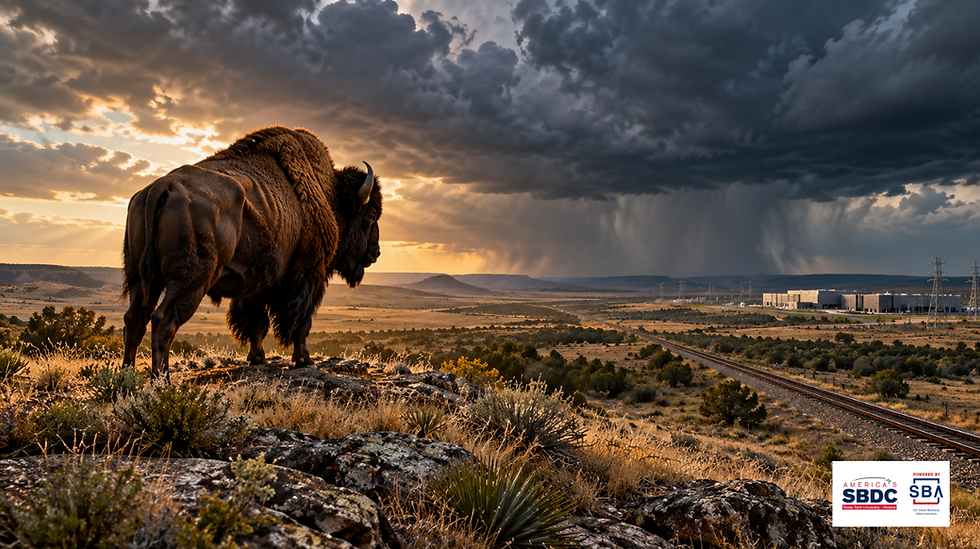
That brings me to the buffalo.
There is a popular story that buffalo charge directly through storms while cattle run away from them. Like many stories that eventually become business metaphors, the version repeated online is often more dramatic than the actual animal behavior. Fortunately, the reality is useful enough without embellishment.
The National Park Service describes bison as remarkably well adapted to severe winter conditions. Their heavy coats provide tremendous insulation, and during winter storms bison may turn toward the incoming weather, lower their profile, and endure it rather than simply turning their backs to the wind. They cannot control the weather around them, but they are equipped to recognize and respond to the conditions they face.
That is the part of the metaphor that matters to me. The buffalo faces what is coming. It does not make the storm disappear, nor does it need to pretend the storm is pleasant. Facing the storm is not an act of optimism. It is a response to reality.
Business owners operate in much the same way within environments they cannot completely control. We cannot dictate economic cycles, technological development, demographic change, customer behavior, competition, labor availability, inflation, regulatory change, or every other force capable of affecting a business. We can influence some things, prepare for others, and respond to many of them, but we cannot prevent the environment around us from changing simply because the current conditions are comfortable.
The storm, however, should not always be interpreted as a catastrophe. Sometimes the storm is simply change, and change can bring opportunity and difficulty at the same time. A new technology may threaten an established process while opening an entirely new market. A major employer entering a community may increase competition for workers while also creating new customers and demand for local services. A demographic shift may weaken demand for one product while creating demand for another. New infrastructure may disrupt familiar patterns while making businesses or industries possible that could not have existed there before.
That complexity is important because business owners do not have the luxury of sorting every change neatly into categories of good or bad. The same development can benefit one business, challenge another, and create entirely different possibilities for a third. What matters is understanding how the environment is changing and what those changes mean for the decisions in front of us.
Being the buffalo, then, does not mean assuming that everything coming toward us is good or that every disruption should be welcomed. It means refusing to turn away simply because the change is uncomfortable or uncertain. We face what is coming, understand it as clearly as we can, and then decide how we will respond while we still have choices about what comes next.
Abilene Has Been Here Before
Living and working in Abilene makes that idea particularly meaningful to me because the history of this community is, in many ways, a history of people responding to changing conditions. Abilene exists because change came to Taylor County, and because people recognized that the arrival of new infrastructure could alter what was possible for the region.
Before Abilene became the center of the county, Buffalo Gap was the county seat. By 1880, Buffalo Gap had approximately 1,200 residents, along with stores, a hotel, a blacksmith and carriage shop, a jail, and other businesses. It was not an empty patch of ground waiting for something better to arrive. It was an established community serving the needs of the people who lived in and around it.
Then the Texas and Pacific Railway began pushing west, and the economic environment of the county began to change. Several ranchers and businessmen recognized what the railroad could mean and worked with the railroad's townsite locator to bring the route through the northern portion of Taylor County. A new townsite was established along the route, the railroad arrived in 1881, and Abilene began to grow. By 1883, Abilene had replaced Buffalo Gap as the county seat.
The significance of that history is not simply that a railroad arrived. The railroad altered the economic geography of the region by changing where people, goods, businesses, and capital could move. Taylor County became more directly connected to national markets, settlement accelerated, and Abilene developed into a shipping center. Infrastructure created access, and that access created possibilities that had not existed in the same way before.
That transition did not benefit everyone equally. Buffalo Gap's population declined after the railroad bypassed it, and Abilene's rise changed the balance of economic and political activity within the county. That is an important part of the story because change rarely produces only opportunity. It can also disrupt communities, alter established patterns, and force people and businesses to respond to conditions they did not choose.
The larger lesson is that the environment changed, and people made choices in response to it. Abilene continued doing that long after the first train arrived. Each generation encountered different constraints and opportunities, and the community repeatedly adjusted to what the changing environment required.
Water scarcity forced Abilene to think about how a growing West Texas city could sustain itself. Agriculture evolved as producers responded to changing markets and conditions. Transportation expanded. Oil and commerce added new dimensions to the regional economy. Educational institutions grew and became increasingly important to the community. Healthcare expanded. Local leaders pursued military investment, and what ultimately became Dyess Air Force Base developed into one of the defining institutions of modern Abilene.
None of those developments required everything that came before them to disappear. Agriculture remained important even as other industries emerged. The railroad continued to matter even as highways and air transportation expanded. Existing businesses adapted while new kinds of businesses took root. Abilene's economy did not evolve by repeatedly erasing its past. It evolved by adding new layers to what was already here.
That distinction is important because adaptation is not always about replacing the old with the new. Sometimes the wiser response is to preserve what continues to create value while building new capabilities around it. Abilene's history shows that growth often comes not from abandoning what a community already is, but from expanding what it is capable of becoming.
Another Kind of Railroad
More than 140 years after the arrival of the Texas and Pacific Railway, Abilene may again be standing beside infrastructure capable of changing what is possible here. This time there are no tracks being driven west across the prairie. The infrastructure is built around electrical capacity, fiber connectivity, computing systems, data centers, and artificial intelligence.
The Stargate development near Abilene is already operating portions of its computing infrastructure. OpenAI identifies Abilene as the first Stargate site and says the facility is already training and serving frontier AI systems. OpenAI has also begun its first Stargate-community OpenAI Academy programming in Abilene, providing AI training for local businesses, students, educators, and other members of the community. Taken together, those developments place Abilene in a technological environment that would have been difficult to imagine for the region only a few years ago.
The economic activity associated with construction has been substantial, but it is important to understand the nature of that activity. Thousands of workers have been associated with the buildout, including electricians, equipment operators, construction workers, technicians, and other specialized occupations. OpenAI distinguishes short-term construction roles from the direct full-time jobs needed to operate Stargate data centers. Independent analysis describes the longer-term operational workforce as smaller and more specialized than the workforce required during construction.
Abilene's own financial experience reflects that distinction. The City expects a $19.3 million one-time sales-tax surplus associated with data-center construction and has deliberately directed that temporary revenue toward one-time capital expenses rather than incorporating it into recurring operating costs. That is a prudent recognition that the intense level of construction activity occurring today should not automatically be treated as a permanent feature of the local economy.
The same caution applies to employment. The permanent operating workforce should not be confused with the much larger construction workforce required to build facilities of this scale. An earlier City of Abilene planning report cited approximately 57 new full-time jobs for the data-center development. Because the project has evolved substantially since that estimate was developed, the figure is best understood as a historical planning estimate rather than a current projection of Stargate's eventual operational workforce.
Understanding that difference does not diminish the significance of the development. It changes the way we should evaluate its longer-term importance. If we measure the impact of these data centers only by counting the number of people who will eventually work inside them, we may be focusing on the most visible number while overlooking the larger economic question.
The railroad offers a useful comparison. Its importance to Abilene was never limited to the number of people employed by the railroad itself. It gave businesses greater access to markets, changed how goods could move, attracted people and capital, and altered the economics of where businesses could locate and what activities could develop around them.
The tracks were the infrastructure. Much of the larger economic story came from what that infrastructure made possible.
The same possibility exists today. That does not mean a twenty-first-century data center and a nineteenth-century railroad are economically identical, because they are not. Nor does it mean that Abilene has literally become an Internet interchange in the technical networking sense simply because large-scale computing infrastructure has been built here. The comparison is about the role infrastructure can play in changing a region's relationship with the broader economy.
Abilene was once situated along a physical transportation network that connected it more directly to the movement of people, goods, and capital. Today, the region is becoming home to infrastructure built around enormous flows of electrical power, computing capacity, data, and digital activity. In that sense, Abilene may be becoming a junction of another kind, not along a railroad carrying physical goods, but within an emerging network built around the movement and processing of information.
The first railroad tracks did not determine everything Abilene would eventually become, but they changed what could happen here. Large-scale AI infrastructure may represent a similar moment. Its presence does not guarantee that a broader technology economy will emerge, nor does it tell us exactly what industries, businesses, or opportunities might follow. What it does demonstrate is that something previously unusual for this region is now possible here: enormous investments in advanced computing infrastructure can be developed and operated in West Texas.
The important distinction is between what will happen and what could happen. The first invites prediction. The second invites preparation, imagination, and choice. Infrastructure can create possibility, but infrastructure alone does not determine what comes next.
The Buffalo Framework
The buffalo is useful as a metaphor, but a metaphor alone does not help a business owner decide what to do when conditions begin to change. Facing the storm sounds good in principle. The harder question is what facing it actually requires when customers are behaving differently, technology is changing an industry, costs are rising, a new competitor enters the market, or an unexpected opportunity appears.
That is where the idea has to become practical. Facing change is useful only if it affects the way we observe, evaluate, and make decisions about the business. Otherwise, Be the Buffalo becomes little more than encouragement to persevere, and perseverance by itself is not always the right response. Sometimes we should continue forward. Sometimes we should change direction. Sometimes we should protect what is already working, and sometimes we need to recognize that what worked before may no longer be enough.
For a business owner, being the buffalo means developing a disciplined way of responding to changing conditions while enough time, information, and flexibility remain to make meaningful choices. The objective is not to predict every change before it occurs or react to every new development simply because it is new. It is to understand the environment clearly enough to recognize when something meaningful is changing, determine what that change means for the business, and decide how to respond before circumstances make the decision for us.
The Buffalo Framework is built around that idea. It begins with seeing the environment as it actually is, then moves through understanding change, identifying where expectations and results separate, protecting what continues to create value, preserving choices, and recognizing the opportunities that a changing environment may create.
See the Environment Clearly
The first responsibility is to understand what is actually happening. That sounds simple, but business owners are constantly interpreting reality through experience, expectations, habits, fears, and hopes. We see what has worked before and assume it will continue working. We become excited about a new opportunity and overlook evidence that complicates the story. We become skeptical of a new technology and dismiss it before taking the time to understand what it might change.
Seeing the environment clearly requires us to separate observation from interpretation. The two are easy to confuse because interpretation often happens almost immediately. We see a change in sales, customer traffic, employee behavior, or costs and begin explaining why it happened before we have gathered enough information to know whether our explanation is correct.
A business experiencing declining foot traffic, for example, might initially conclude that customers no longer want its products. That is one possible interpretation, but it is not the only one. Customers may still want the products while increasingly expecting to discover, evaluate, or purchase them differently. The problem may not be demand for the product at all. It may be where, when, or how the customer expects to interact with the business.
A contractor struggling to find workers might similarly conclude that people simply do not want to work. A closer examination could reveal something very different: competing employers may be paying substantially more, the region may have too few trained workers, demographic changes may have reduced the available labor pool, or the workforce pipeline may simply be incapable of producing skilled employees quickly enough to meet demand.
Those explanations matter because each one points toward a different response. If the problem is compensation, the business faces one set of choices. If the problem is training capacity, it faces another. If customer behavior has changed, the appropriate response may involve a different sales channel rather than a different product. Acting on the wrong interpretation can lead a business to solve a problem that does not actually exist while the real problem continues to grow.
The objective is not to become perfectly objective. None of us are. Experience and judgment will always influence the way we interpret what we see, and those instincts can be valuable. The goal is to become willing to challenge our first explanation, especially when the evidence does not fit comfortably within it.
Before deciding whether the glass is half full or half empty, understand what is actually in the glass, why its level changed, and whether the glass itself is still the right thing to be measuring.
Face the Change
Once change becomes visible, we have to decide how we will respond to it. Ignoring an uncomfortable development does not preserve the conditions that existed before it. A competitor does not disappear because we choose not to study them, customers do not reverse their behavior because we prefer the old way, and a new technology does not become irrelevant simply because we are skeptical of it.
Facing change does not mean reacting immediately to everything new. Not every trend becomes permanent, not every technology delivers what it promises, and not every disruption requires a change in strategy. Sometimes the correct response is to watch, learn, gather information, and wait.
The important distinction is whether waiting is deliberate. A business owner who decides to monitor a developing situation while gathering evidence is still making a decision. A business owner who refuses to examine the situation because it is uncomfortable is surrendering that decision to circumstances.
Being the buffalo requires judgment rather than panic. The goal is not constant movement. It is remaining sufficiently aware of changing conditions to know when observation is still appropriate and when waiting is beginning to reduce the choices available.
Find the Point of Failure
Earlier, I argued that the point of failure is where the expected result begins to separate from the actual one. Within the framework, the practical task is to locate that point as specifically as possible rather than labeling the entire effort a failure.
Suppose a restaurant introduces online ordering and sales do not increase. The useful question is not simply whether online ordering worked. Was the service promoted adequately? Was the ordering process cumbersome? Did delivery fees make the final price unattractive? Did the menu translate poorly to an online format? Or did the restaurant solve a problem its customers did not actually have?
Each answer suggests a different response. One may require better promotion, another a different ordering system, another a revised pricing model, and another the decision to discontinue the effort entirely.
The purpose is diagnosis. Once the failure becomes specific, we can examine assumptions, execution, timing, resources, and the objective itself. That gives us a better basis for deciding whether to repair the approach, redesign it, or move in another direction.
Protect What Still Works
Adaptation should not become an excuse to destroy everything familiar. Businesses accumulate knowledge, relationships, capabilities, reputations, and practices that may continue creating value even as the environment changes.
The challenge is identifying what actually deserves protection. A useful distinction is between the value a business creates and the method currently used to create or deliver it. Those are not always the same thing.
A trusted relationship may remain essential even if the way customers communicate changes. A core service may continue solving the same customer problem even if technology changes how the service is delivered. A reputation for reliability may remain central to the business even while the processes supporting that reliability are redesigned.
That is where if it ain't broke, don't fix it retains its wisdom without becoming an excuse for inaction. Protect what continues to create meaningful value, but do not assume that preserving the value requires preserving every method associated with it.
Sometimes maintaining what matters most requires changing how it is delivered.
Choose Before Choice Disappears
There is a significant difference between adaptation and reaction. Adaptation occurs while meaningful options still exist, while reaction begins after circumstances have already started narrowing them. The earlier a business recognizes a meaningful shift, the more room it usually has to test, adjust, and decide rather than simply respond under pressure.
A business that recognizes declining demand early may have time to test new products, explore different customer segments, change pricing, retrain employees, adopt new technology, or gradually shift resources. Those choices may not all work, but they give the business room to learn before the situation becomes critical.
A business that waits until revenue has collapsed may face a very different set of decisions. Cash may be limited, employees may already be leaving, lenders may be less willing to extend credit, and customers may have moved on. At that point, the business is no longer choosing from a broad set of strategic options. It is reacting to constraints that have already been imposed by the situation.
The objective is not to predict the future perfectly. Business owners have never possessed that ability, and no forecasting model is going to change it. The goal is to recognize meaningful change early enough to preserve flexibility and create time for deliberate decision-making.
That is also why perspective matters. When we insist on seeing a situation only one way, we can overlook alternatives that might still be available. We may keep protecting an assumption, a product, a process, or a strategy long after the evidence has begun suggesting that something needs to change.
Looking again does not guarantee that a better option will appear, but it gives us a chance to see one before circumstances remove it.
In business, preserving choice is often one of the most valuable advantages we can create for ourselves.
Build Around the Opportunity
This may be the most important part of the framework for Abilene right now because the arrival of a project as large as Stargate can easily narrow our attention to the project itself. We count construction jobs, estimate permanent jobs, examine the tax base, consider utility requirements, watch housing effects, and try to understand the immediate economic impact.
Those things matter, but the property line should not become the boundary of our imagination. Large investments can alter the surrounding economic environment by creating demand, exposing shortages, influencing workforce decisions, and changing the way businesses and investors view a region.
We are already seeing some of those effects in Abilene. Data-center construction has increased demand for skilled trades, particularly electricians, and that competition for workers can create higher labor costs, recruitment difficulties, and project delays for existing businesses.
Those pressures also tell us something. When a region suddenly needs more electricians than it has available, the shortage becomes information about training demand, career opportunities, workforce development, and potential supporting services. The same conditions that create difficulty for one part of the economy may reveal where capacity needs to be built in another.
The principle extends beyond construction. Large-scale computing infrastructure raises questions about the capabilities that may become increasingly valuable over time. What skills will businesses need? What supporting services may be required? Where might opportunities develop in cybersecurity, telecommunications, electrical and mechanical systems, maintenance, technical services, logistics, or professional services?
Those questions are not predictions; they are a way of examining what the changing environment may make possible.
The presence of the data center also changes the way Abilene can be perceived. Major computing infrastructure can be developed here. Significant capital can be deployed here. A global technology project can operate here. Workforce and educational institutions can begin developing capabilities connected to an emerging AI and advanced-computing economy.
None of that guarantees that a technology cluster will emerge. The opportunity is to recognize that the environment has changed and begin asking what new needs, skills, businesses, and relationships may develop around it.
What Will We Become Because It Is Here?
That may be the most important question facing Abilene in this moment. The number of people who will eventually work inside the data center is certainly an important economic-development measure, and it should be understood clearly. But permanent employment alone is too narrow a lens through which to evaluate what infrastructure on this scale could mean for the region.
A larger question is what can exist in Abilene now that might not have existed here before.
The significance of that question is not limited to technology companies. New infrastructure can affect the skills people choose to develop, the services businesses provide, the kinds of investments entrepreneurs consider, and the way outside companies evaluate a community.
That does not mean every possibility will become reality. Infrastructure creates conditions; people still have to decide what to do with them.
That responsibility does not belong only to government or economic-development organizations. Educators have to consider what skills may matter in a changing economy. Entrepreneurs can look for unmet needs created by new activity. Existing businesses can evaluate whether new customers, suppliers, or markets are emerging. Workforce organizations can think not only about today's vacancies but about the occupations that may be needed several years from now. Young people making decisions about education and careers can consider opportunities that may not have existed in Abilene a generation earlier.
Investors and businesses outside the region may also begin seeing Abilene differently. The presence of major computing infrastructure demonstrates a level of capability that can become part of the community's economic identity, just as earlier infrastructure and institutions changed the way Abilene was connected to other parts of the economy.
That is where the railroad comparison matters most. The first train arriving in 1881 did not dictate Abilene's future. It changed the range of futures that were possible. What followed depended upon the decisions people made around that new connectivity.
We do not know whether the same magnitude of transformation will occur around today's digital infrastructure, and we should not pretend that we do. But recognizing that the range of possibilities may have changed is itself important.
The opportunity belongs, in some measure, to the community as a whole. Different people and organizations will respond in different ways, and some ideas will succeed while others will reach their own points of failure. What matters is that we recognize the changing environment early enough to participate in shaping what comes next.
Sometimes the disruption moving toward us is not destruction. Sometimes it is opportunity arriving in an unfamiliar form.
Being the buffalo means being willing to face both.
I Still Don't Know About the Glass
I still cannot tell you whether the glass is half full or half empty, and I am no longer sure that I care. What I have learned is that there is rarely only one useful way to look at the situation in front of us, and changing our perspective does not require us to deny the facts.
Looking from another angle does not change what happened. It can, however, change what we are able to see within it. A different perspective can reveal the point where something failed and give us an opportunity to correct it. It can show us something valuable that should be protected rather than discarded. It can reveal that a successful business model is beginning to encounter conditions for which it was never designed. Sometimes it can even reveal an opportunity that did not exist until the environment around us changed.
That is why I no longer view failure only as an ending. Failure contains information, and information can expand our understanding of what happened, why it happened, and what choices may still be available. Understanding the point of failure does not guarantee that we can repair what went wrong, but it gives us a better basis for deciding whether to try again, change direction, or begin something different.
The same is true of change. We can wait until changing conditions narrow our choices and force us to respond, or we can recognize those conditions while enough flexibility remains to decide what we want to do about them. That does not require us to predict the future. It requires us to pay attention to the present closely enough to notice when the assumptions supporting our past success are beginning to shift.
Abilene has faced that kind of moment before, and it may be facing another one now. We do not yet know everything the arrival of large-scale computing infrastructure will mean, and we should not pretend that we do. What we can do is recognize that the environment around us is changing and ask what that change makes possible.
We can protect what continues to create value without assuming that everything familiar must remain unchanged. We can acknowledge the difficulties that accompany growth and disruption without allowing those difficulties to become the only things we see. We can learn from the places where our expectations and results separate. And we can remain attentive to possibilities that may not have existed before.
The world is going to change whether our businesses are ready for it or not. Our responsibility is not to control that change, nor is it to greet every new development with unquestioning optimism. It is to understand what is happening while we still have meaningful choices about how to respond.
See what is coming and understand what it means. Protect what still matters while remaining willing to change what no longer serves the business. Learn from what fails. Recognize what becomes possible, and make deliberate choices about what comes next.
Be the Buffalo.
References
National Park Service. Bison Bellows: The Winter Survivor; Bison, Buffalo, Tatanka: Bovids of the Badlands.
Texas State Historical Association. Abilene, TX; Buffalo Gap, TX; Taylor County.
City of Abilene. Planning and Development Services reports; FY2026 Revised Budget and FY2027 budget information related to data-center development.
OpenAI. Stargate Community; Stargate infrastructure and workforce-development announcements; OpenAI Academy Abilene resources.
The Texas Tribune. Reporting on data-center construction and skilled-trades workforce impacts in Abilene and Texas.
Be the Buffalo | By Manzel McGhee Jr., ASBC® | Abilene SBDC


